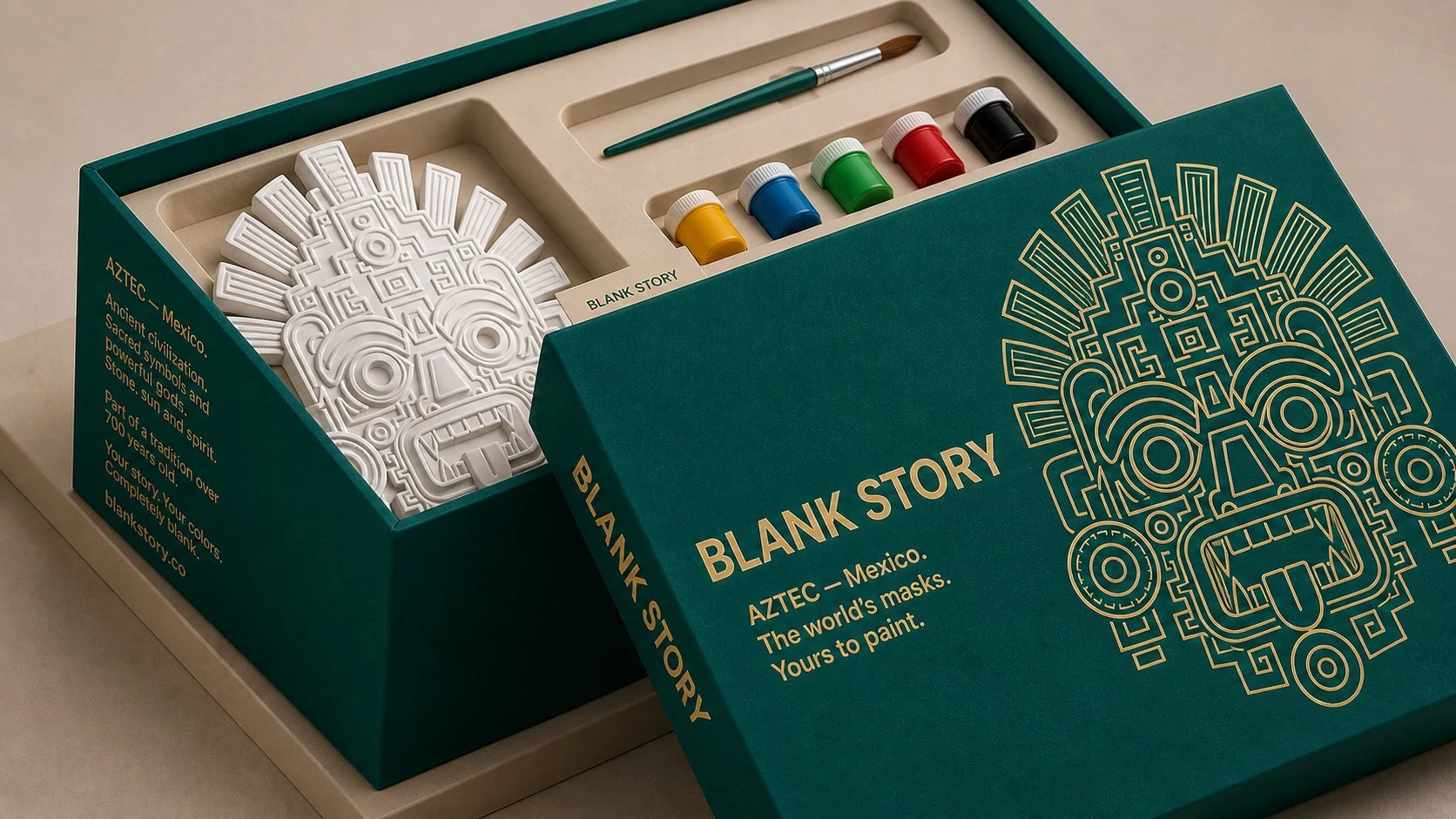
The empire that inherited everything and refined it
The Aztecs, properly the Mexica, rose to power in the Valley of Mexico in the 14th century, building their capital Tenochtitlan around 1345. By the time the Spanish arrived in 1519, they had built one of the largest cities on earth. Beneath it lay the ruins of earlier civilizations they revered: the Olmec, Teotihuacano, Toltec.
Skilled artisans called toltecatl, a title evoking the legendary Toltec craftsmen they aspired to emulate, worked under state and temple patronage. When archaeologists excavated the Templo Mayor from 1978 onward, they found over 12,000 offerings in its foundations. Masks were among the most common. Ancient masks found at Teotihuacan, centuries old when the Aztecs discovered them, were reburied as sacred objects. The Aztecs did not just use masks. They collected them.
Turquoise on bone, and the skull that sees for the god
The Tezcatlipoca skull mask, now in the British Museum, is built on a real human skull. Alternating bands of turquoise and lignite mosaic cover the front. The eye sockets hold iron pyrite discs in rings of shell that catch light and seem to glow. The jaw is moveable, hinged on leather lining the skull's interior. Tezcatlipoca, the "Smoking Mirror", was one of the four creator deities, god of warriors and sorcerers, and cosmic rival to Quetzalcoatl.
The Quetzalcoatl serpent mask, also in the British Museum, is cedrela wood covered with two intertwined turquoise serpents, one green and one blue,, looping across the face. The teeth are carved from conch shell. When Hernán Cortés arrived in 1519, Moctezuma II reportedly believed he might be Quetzalcoatl returning. This mask was among the gifts sent to him.
The smoking mirror, and what survived the conquest
The Spanish conquest of Tenochtitlan in 1521 demolished temples, burned books, and suppressed Aztec religious practice. Yet the mask tradition survived, transformed. The Aztec celebration of the dead was fused with All Saints' Day to become Día de los Muertos.
UNESCO inscribed Día de los Muertos in 2008. La Catrina, a skeleton in a European hat created by José Guadalupe Posada, has become its icon: a commentary on death's democracy, and a direct descendant of the Aztec skull. In 2025, archaeologists announced new finds at the Templo Mayor excavation. Tenochtitlan has not finished speaking.