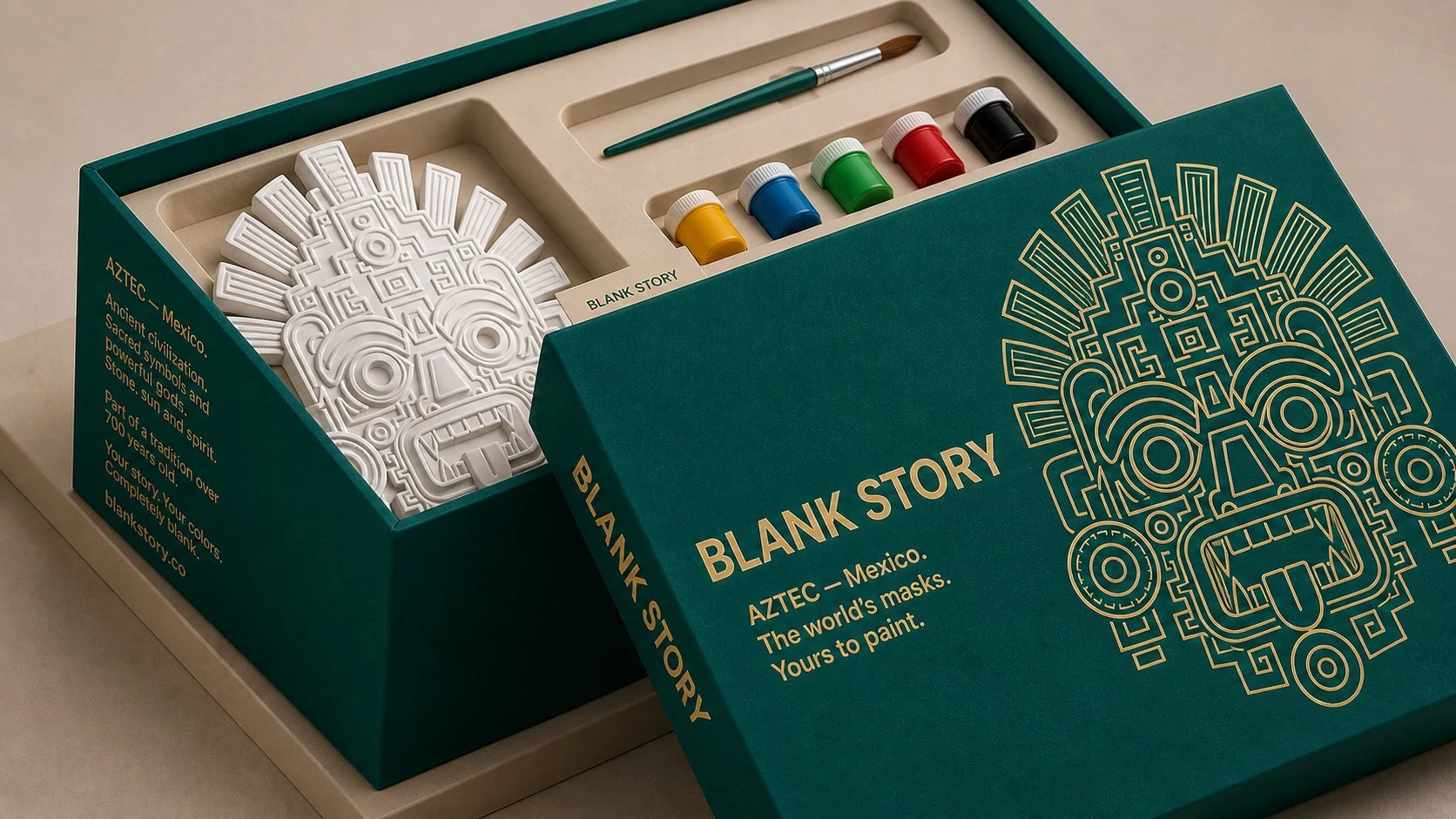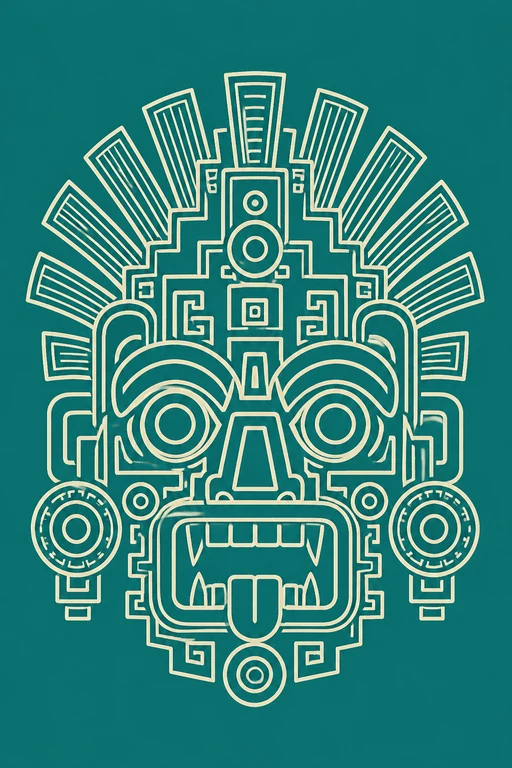
Illustration of the planned Aztec mask, not yet in production
Mask Nº 07
Mexico
Launching 2027
Launch list open

Aztec

A mask built on bone.

Mēxihcah · Az · té · catl

Cast by hand · Painted by you

Coming 2027 Arriving 2027. Hanuman is first. Same object, same box, same price across the collection. See Hanuman

Mēxihcah · Mexico

Thousands of turquoise chips the size of a grain of rice, set in resin, over a real human skull.

Chapter one

An empire that inherited and refined

The Mexica did not invent mosaic work. They took a Mesoamerican tradition running back through the Mixtec and the Toltec and further, and pushed it harder than anybody before them, with tribute lists that specify turquoise by the load and by the province.

The stone came up from what is now the American southwest, hundreds of miles on foot, through territory the empire did not control. It was worth more than gold, because gold you could melt down and turquoise you had to find.

The finest pieces were made by Mixtec specialists working for Mexica patrons, which is a distinction most gallery labels quietly skip.

Codex Mendoza, folio 65r, c. 1541  Bodleian Library

Codex Mendoza, folio 65r, c. 1541 · Bodleian Library

Chapter two

Turquoise on bone, and eyes that see for the god

The best known example is Tezcatlipoca, the smoking mirror. It is built on a real human skull, faced in alternating bands of turquoise and black lignite, with eyes of polished pyrite ringed in white conch shell.

The back of the skull was cut away and lined with deerskin so it could be worn or hung, and the jaw is articulated on leather straps. Whoever made it intended it to move.

These were not portraits of anybody. They were worn by, or laid on, the images of gods, and it is the eyes that unsettle people standing in front of the case, because after five hundred years they are still bright.

Codex Borbonicus, folio 13

Codex Borbonicus, folio 13

Chapter three

What survived the conquest

Most of it was melted, buried or smashed. A handful of mosaic pieces travelled to Europe in the first shipments to Charles V and are now in London, Rome and Copenhagen, and that handful is close to the entire surviving record.

What we know about how they were used comes mostly from the codices, the Mendoza and the Borbonicus among them, painted by Mexica scribes in the decades after the conquest for European readers who wanted to understand what they had just destroyed.

Around ten complete turquoise mosaics survive worldwide. Every one of them sits in a museum outside Mexico.

They were not portraits of anybody. They were worn by the images of gods.

Chapter four

So we cast it blank

Ours is plaster, and every tessera is a raised facet in the relief rather than a chip of stone. That is exactly the point: the grid is there, and the colour is not.

Blue-green over bone white, black where the lignite runs, and a hard glint where the eyes should be.

Mask Nº 07 · Mexico · 2027

Aztec

A mask built on bone.

01 / Cast

Poured by hand

Premium plaster, one at a time, in the house on the Siem Reap River.

02 / Blank

Finished smooth

No colour. The sculpt is the guide: raised edges catch the brush and hold it where it belongs.

03 / Painted

Turquoise, shell, obsidian

Blue-green over bone white, black where the lignite runs, and a hard glint where the eyes should be.

Five pots · one brush
1

Mask per box

5

Pots of colour

What’s inside the box

Everything you need. Nothing you don’t.

One mask, five pots of colour, one real brush, a story card. Nestled in a foam tray inside a coloured box. Every mask in the collection ships the same way.

01
The mask

Cast by hand in premium plaster at the house in Siem Reap. Every carved line of the original is there in relief before a brush touches it.

02
Five pots

Water-based colour, non-toxic, off a table with a damp cloth. The five change per mask to match the tradition it comes from.

03
One brush

Real fibre, real spring. The kind you keep in the pencil pot long after the mask is finished and on a shelf.

At a glance

The original, on paper.

What the mask is in its own tradition, before we cast a copy in plaster and sent it out white.

Tradition
Mexica and Mixtec mosaic work
Best known example
Tezcatlipoca, British Museum
Original material
Turquoise, lignite, shell, pyrite, pine resin
Base
Human skull, backed with deerskin
Traded from
The American southwest, on foot
Survivors
A handful, in European collections
Our version
Premium plaster, hand-cast in Siem Reap
On sale
2027
Give-back
Free art classes, Siem Reap

Answers to the usual.

Yes. Water-based, non-toxic, and it comes off skin and off a table with a damp cloth. Built for a kitchen table on a Sunday.

A story card with the history and the traditional colours, so you know what you are looking at. No paint-by-numbers. The mask ships white on purpose.

Resin is cheaper to ship and it feels like a phone case. Plaster takes paint properly, keeps a sharp edge on every carved line, and has the weight that puts a thing on a shelf instead of in a drawer.

Aztec arrives in 2027. We will not put a month against it until the moulds are cut and the first run is right.

Yes, and we would like that. Minimum order is one case of four, prepaid, and you can collect from the office in Siem Reap if that suits you better than freight. Full pricing and terms sit behind a trade login. Write to us with the name of the shop and we will send a code the same day.

Not yet available

Hear about it first.

Aztec lands in 2027. Leave your email and you will know the day it does.

One email when it is live. Nothing else, ever.

Thank you. You are on the list.