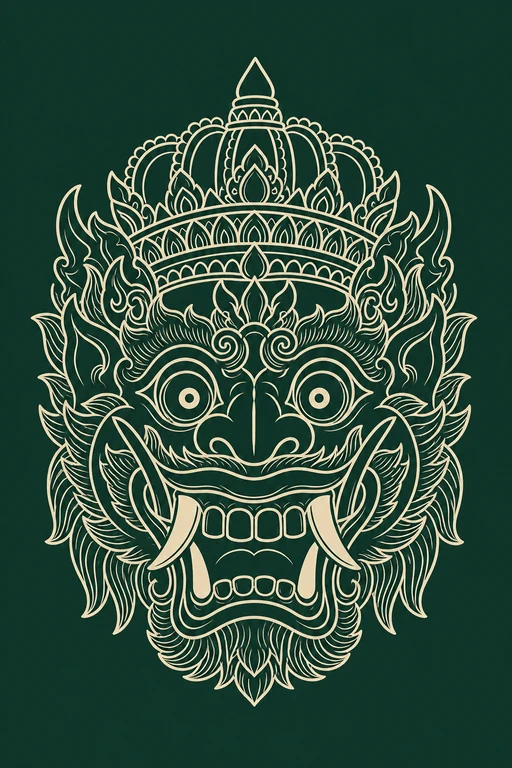
Good and evil, forever in balance
The Barong predates Hinduism in Bali. It likely descends from Austronesian guardian-animal traditions before the Majapahit kingdom arrived (14th–16th centuries) and gave it new mythology. The core Balinese principle that Barong embodies is rwa bhineda: good and evil are not enemies to be defeated but eternal complements that must be kept in balance.
The central drama is the Calon Arang, an 11th-century Old Javanese text dramatized into Balinese form in the 1890s. The widow-witch Rangda (the word means "widow") unleashes plague and demons. Barong intervenes, not to destroy her, but to protect his people and restore equilibrium that can never be made permanent.
Carved from sacred wood, on sacred days
Masks are carved from pule wood (Alstonia scholaris), chosen specifically for spiritual receptivity. The carving happens on auspicious days, with ritual offerings at every stage. The beard is human hair adorned with frangipani. Balinese belief holds that Barong's magical power resides in the eyes and beard, the living parts, where the spirit enters.
A Barong mask is not a prop. It has a name. It has a personality. It has needs. It requires regular ceremony and care. It cannot be stored carelessly.
The dance that can make men invulnerable
The climax of a Calonarang performance is the onying, the kris dance. Male dancers fall into trance and turn their daggers on themselves. Barong's protection, it is believed, makes them invulnerable. The faith is real, and the stakes are real.
UNESCO inscribed the Three Genres of Balinese Dance in 2015. Barong is performed daily for tourists at Batubulan and Ubud, in Bali, a dance performed for tourists is still a Barong dance. The spirit attends regardless of who is watching.