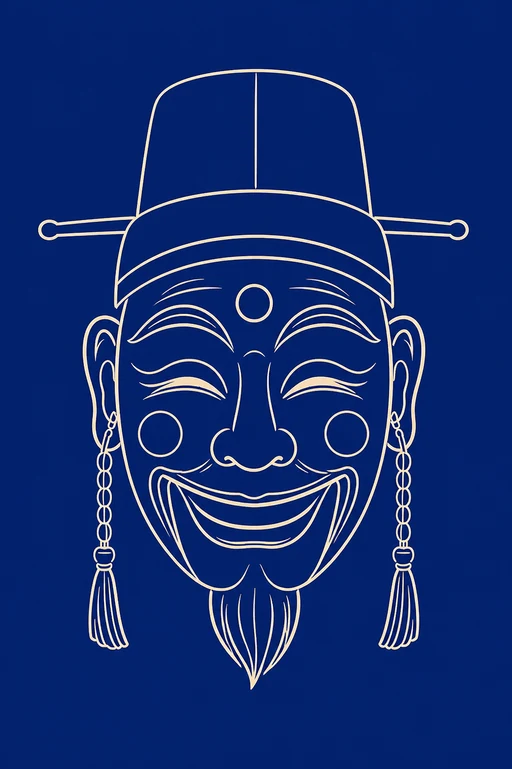
A carver who died for his art
The Hahoe masks come from a village in Andong, Korea's North Gyeongsang Province. Made for the Hahoe Byeolsingut Talnori, a shamanic drama performed to appease the village goddess Seonangsin, they date to the mid-Goryeo period, roughly the 12th century.
Their origin story is the most haunting in this collection. A craftsman named Heo Doryeong was instructed in a dream to carve twelve masks in total isolation, without allowing anyone to see. On the ninety-ninth day, his sweetheart looked through the paper window. He collapsed, vomited blood, and died, still carving the final mask, Imae the fool, who remains forever without a chin.
Built to say two things at once
Unlike most Korean ritual masks, which are ceremonially burned after each performance, released back to the spirit world. Hahoe masks are permanent. They survive. They accumulate history in their grain.
The Yangban (aristocrat), Seonbi (scholar), Jung (monk), and Baekjeong (butcher) masks have moveable jaws, hinged with cord. Female characters do not. The privilege of speech, literally carved into the material.
Satire as survival
Through characters like the Yangban and the corrupt monk, the drama mocks the ruling class. The emotion underneath is han, a Korean word with no exact English equivalent:: something between grief, resentment, and a long accumulated sorrow that refuses to disappear.
UNESCO inscribed Korean Talchum mask dance on November 30, 2022. The Andong International Maskdance Festival drew over 1.2 million spectators in 2025. Queen Elizabeth II celebrated her 73rd birthday watching the masks perform in Hahoe village.