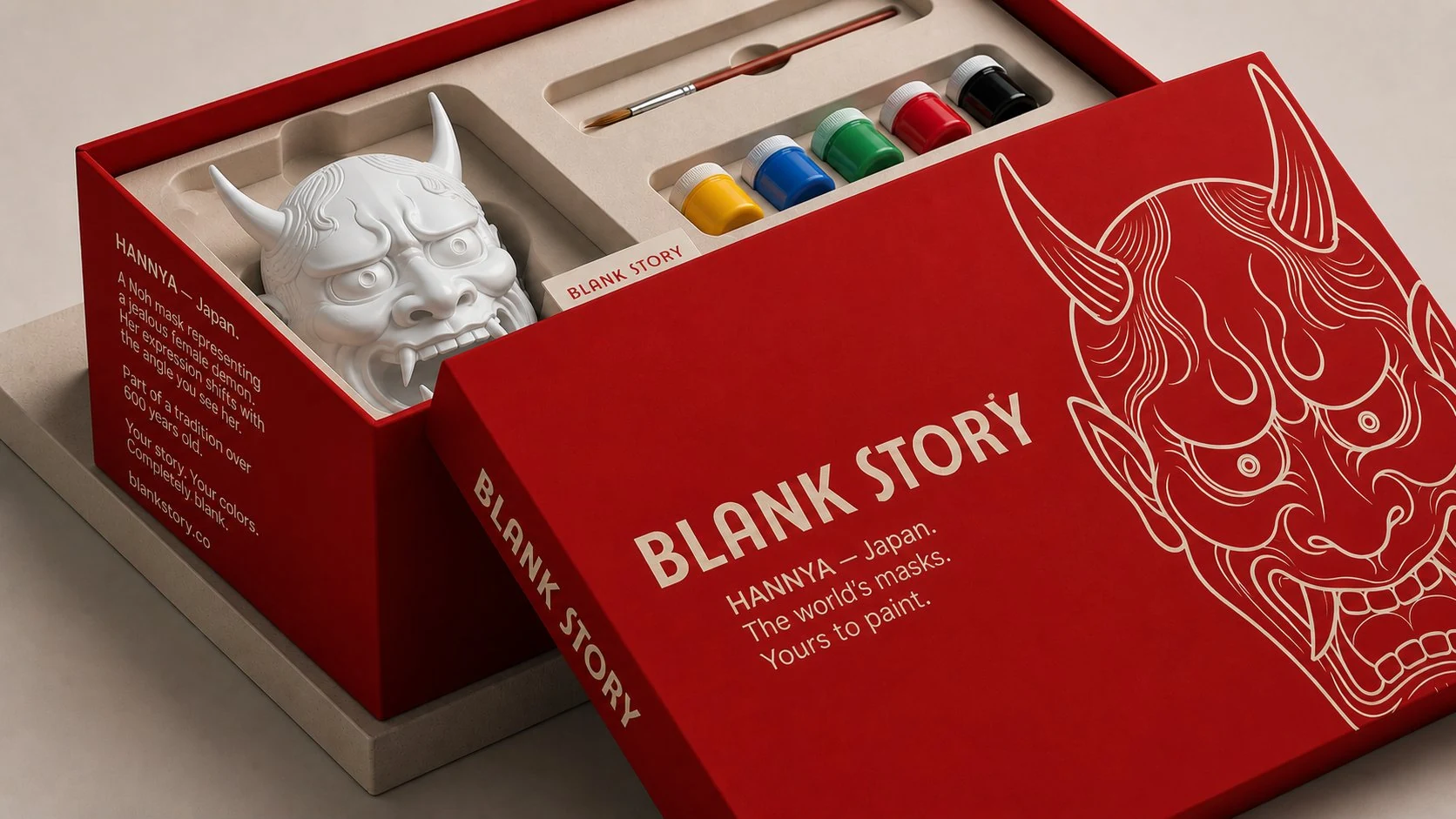
When love becomes something else
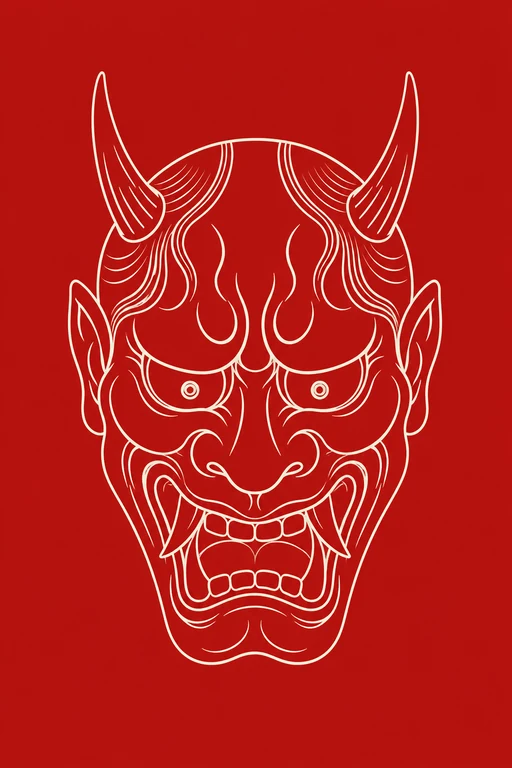
The Hannya mask was born in Japanese Noh theater during the late Muromachi period, around the 15th to 16th century. The oldest preserved example dates to roughly 1558. It depicts not a demon by nature, but a woman transformed by obsessive jealousy, the specific emotional state that medieval Japanese Buddhism considered the most dangerous condition the human mind could enter.
Two stories anchor it. Lady Rokujō, the spurned mistress of The Tale of Genji, sends her living spirit out at night to torment Genji's wife. And Kiyohime, who falls in love with the monk Anchin, pursues him across a river after he rejects her, transforms into a fire serpent, and melts the temple bell beneath which he hides.
Carved from a single block of cypress
A traditional Hannya mask is carved from aged hinoki, Japanese cypress, from a single block. Horns are socketed into the forehead. Gilded brass plates are inset for the eyes and teeth. The craftsmanship takes months; the expression years to master.
Color is class and psychology in one. White (shiro hannya) for refined aristocrats like Lady Rokujō. Red (aka hannya) for commoners, fiercer, more animalistic. Deep red for the fully serpentine demon, beyond all social category.
From temple stage to global iconography
The Hannya has escaped its stage. In traditional Japanese irezumi tattooing, it appears alongside snakes and peonies as a talisman of female strength. It saturates anime, video games, and streetwear. At Shinto weddings, the bride wears a tsunokakushi, a "horn hider", symbolizing her commitment to conceal the potential horns of jealousy.
UNESCO inscribed Nōgaku theatre in 2008. The Tokyo National Museum holds 47 Konparu-school masks, several designated Important Cultural Properties.